I love summer gardening, and this is kind of challenging too for a lot of gardeners due to the unpleasant heat. You are not alone in seeing wilting plants, sunburn on leaves, and soil drying out too fast.
The only solution to all these problems is using Shade cloths...
I don’t start writing an article until I’m confident that you won’t find anything like it anywhere on the internet. This article is not only about choosing the right shade cloth percentage for plants. There are a lot of different factors that we need to consider before choosing a shade cloth. It's important to understand those factors before choosing a shade cloth blindly.
At first, I will be talking about this basic information you need to know, and then you will find the shade cloth percentage charts.
Types of shade cloth
There are three major types of shade cloths available in the market.
- Shade cloth by percentage (Most common)
- Shade cloth by material
- Shade cloth by color
If you want something that will last the longest, go for Knitted (HDPE). If you want a tighter structure and a more rigid one, Woven will be the best one for you.
Reflective (Aluminet) shade cloth is best for extreme heat areas. It reflects light and heat both and makes the underneath cooler.
In this article, I will be talking about the most common one - shade cloth by percentage. This controls how much sunlight is blocked.
Shade cloth is basically UV-filtering fabric.
I strongly discourage using black shade cloths as it locks light strongly, but heat up more.
I prefer the green one as it gives a natural look and slightly diffused light.
Aluminized (silver) shade cloths might not be pocket-friendly, but they are good at heat reflection.
In summer, I usually find more pests on my raised beds, and I use companion planting to deter pests. You can check my guide on this: Best companion plants for a vegetable garden.
When to use shade cloth and when not to use
There is a temperature threshold for each plant. When the temperature goes above that consistently, the plants start to go into heat shock.
Even the sun-loving plants may go into stress due to the excessive heat.
When heat increases beyond a certain point, photosynthesis slows down, pollen becomes less viable (poor fruit set in tomatoes/peppers), and leaves lose more water than roots can replace.
Those who don't have enough time to read the complete article, this is for you:
Put shade cloth over your plants when
- It's above 85–90°F (29–32°C)
- Strong afternoon sun (2–6 PM)
- During heatwaves
- After transplanting
30–40% shade cloth for Tomatoes, peppers, and other fruiting plants.
40–60% shade cloth → Leafy greens, herbs, flowers.
50–70% → Seedlings, heat-sensitive plants.
70%+ → Extreme heat protection.
If you witness mid-day wilting plants (even if the soil is moist), it's time to put shade cloth.
DO NOT use shade cloths for succulents and cactus plants.
If your plants are newly transplanted and the roots are not established yet, you should start using shade cloths on them. Once the roots are established, you can remove the shade cloths accordingly.
This is why you can see shade cloths in nurseries more often, as they propagate new plants frequently.
If you are not sure what to plant in summer in your garden, you can visit our home page to get planting charts based on your USDA growing zone.
Shade cloth percentage charts
You can choose a shade cloth percentage according to the plant types, sun-intensity, and the current condition of your plant.
| Shade Cloth % | Light Block | Best For | Examples | When to Use |
|---|---|---|---|---|
| 30% | Light Shade | Sun-loving vegetables | Tomatoes, Peppers, Eggplant | Mild heat (85–90°F) |
| 50% | Moderate Shade | Leafy greens & herbs | Lettuce, Spinach, Basil, Cilantro | Warm to hot (90–95°F) |
| 70% | Heavy Shade | Seedlings & shade-loving plants | Nursery plants, Ferns | Extreme heat (95°F+) |
| 90% | Very Heavy Shade | Temporary protection only | Transplants, Heat-stressed plants | Heatwaves / plant recovery |
This is the very basic chart.
If you are growing vegetables in pots, use 40–50% shade cloth. If the plants are still burning, increase shade, and if the plants are leggy, decrease shade.
I have created another useful resource for container gardeners. You can check it after reading this article: How to choose the perfect container/pot size for your plants - Pot size charts for plants.
Now, let's move to some advanced charts.
I am not going to consider temperature here. Instead of that, I am considering Sun intensity (very practical) and stress symptoms.
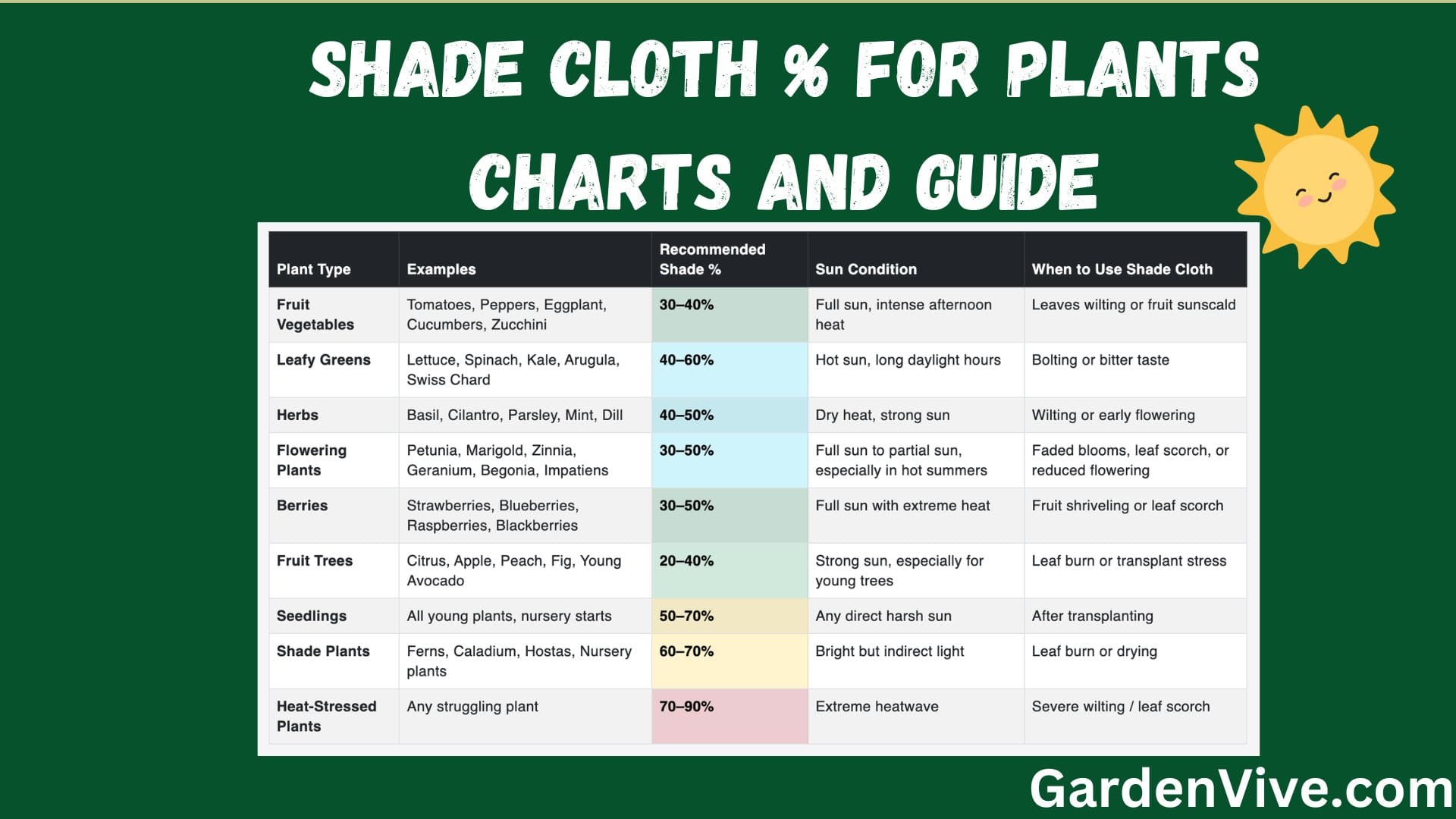
You need to first identify your plant type (if it's fruiting/leafy/seedlings/herbs/flowering/berries, or something else )
When you have finished identifying your plant type, check the condition (wilting, bolting, sunburn, or something else) and pick the shade cloth percentage from my chart.
Stress symptoms can be found in the last column. Swipe the table right to see that.
If your plant is performing well without using any shade cloth, do not put a shade cloth over your plants.
| Plant Type | Examples | Recommended Shade % | Sun Condition | When to Use Shade Cloth |
|---|---|---|---|---|
| Fruit Vegetables | Tomatoes, Peppers, Eggplant, Cucumbers, Zucchini | 30–40% | Full sun, intense afternoon heat | Leaves wilting or fruit sunscald |
| Leafy Greens | Lettuce, Spinach, Kale, Arugula, Swiss Chard | 40–60% | Hot sun, long daylight hours | Bolting or bitter taste |
| Herbs | Basil, Cilantro, Parsley, Mint, Dill | 40–50% | Dry heat, strong sun | Wilting or early flowering |
| Flowering Plants | Petunia, Marigold, Zinnia, Geranium, Begonia, Impatiens | 30–50% | Full sun to partial sun, especially in hot summers | Faded blooms, leaf scorch, or reduced flowering |
| Berries | Strawberries, Blueberries, Raspberries, Blackberries | 30–50% | Full sun with extreme heat | Fruit shriveling or leaf scorch |
| Fruit Trees | Citrus, Apple, Peach, Fig, Young Avocado | 20–40% | Strong sun, especially for young trees | Leaf burn or transplant stress |
| Seedlings | All young plants, nursery starts | 50–70% | Any direct harsh sun | After transplanting |
| Shade Plants | Ferns, Caladium, Hostas, Nursery plants | 60–70% | Bright but indirect light | Leaf burn or drying |
| Heat-Stressed Plants | Any struggling plant | 70–90% | Extreme heatwave | Severe wilting / leaf scorch |
Note: If you are growing plants in smaller raised beds or containers, you may need to increase the shade cloth percentage.
Note: For cacao, you need filtered shade. Just think like “dappled jungle shade”, not full sun and not deep darkness. Shade cloth (40–60%) will be the best. This is an exception.
Most flowering plants need a good amount of sunlight to bloom, but excessive heat can make the flowers fade.
Even too much shade will cause fewer blooms and more leaves.
Did you find it helpful? Subscribe to this site, and I will be back with fresh articles.